
Image:
© Photowitch
| Dreamstime.com
The relationship between vessel utilisation and container spot freight rates is markedly different on the transpacific and Asia-Europe trades.
New analysis from Sea-Intelligence raises questions over how reliably capacity utilisation can predict pricing.
The analyst found a strong correlation between utilisation and spot rates on the transpacific, where freight rates rise sharply once vessel utilisation exceeds 90%.
However, the relationship is considerably weaker on Asia-Europe, where transhipment activity and geopolitical disruptions complicate the traditional supply-demand equation.
Sea-Intelligence compared Drewry’s World Container Index (WCI) spot rates with demand data from Container Trade Statistics (CTS) and capacity figures from its own Trade Capacity Outlook database. The analysis used monthly averages, with September’s the latest data available, and calculated utilisation by dividing loaded cargo volumes by nominal vessel capacity.
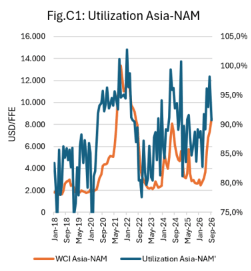
Source: Sea-Intelligence
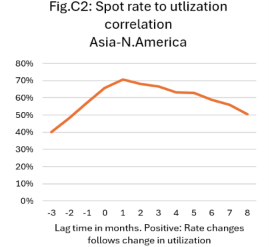
On the transpacific, the analysis identified a clear relationship between utilisation and freight rates, with the strongest correlation, 71%, occurring when spot rates lagged changes in utilisation by one month.
It said this suggested capacity utilisation was a significant driver of spot rate movements, although other factors also influenced pricing.
Source: Sea-Intelligence
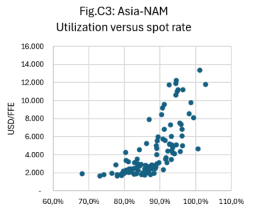
A further analysis of utilisation against spot rates showed freight rates begin climbing steeply once utilisation passes 90%, reflecting a tightening capacity market in which shippers compete for available slots.
Source: Sea-Intelligence
The picture on Asia-Europe was markedly different, however, where Sea-Intelligence found a much weaker relationship between utilisation and freight rates, even after applying three-month rolling averages to smooth out short-term volatility.
Its correlation analysis and scatter plot showed changes in nominal vessel utilisation were a poor indicator of spot rate movements on the trade, which the analyst suggested reflected fundamental differences in the structure of the two trades.
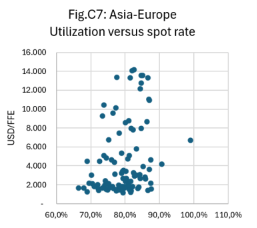
Source: Sea-Intelligence
On the transpacific, most vessel capacity is dedicated to cargo moving between Asia and North America, making utilisation a relatively direct measure of the balance between supply and demand, while Asia-Europe is more complex, as vessels carry cargo for multiple markets through major transhipment hubs along their routes.
Consequently, capacity that appears available on the main Asia-Europe trade may already be committed to cargo moving on other tradelanes.
The analyst also highlighted the impact of the Red Sea and Hormuz crises on vessel deployment, further distorting the relationship between nominal capacity, actual utilisation, and freight rates.
Sea-Intelligence acknowledged that its utilisation calculations had limitations, as nominal capacity did not necessarily reflect the actual space available for cargo, while carriers do not disclose precisely how vessel capacity is allocated between trades.
The findings suggest that while utilisation can provide a useful signal of impending freight rate increases on the transpacific, applying the same metric to Asia-Europe risks overlooking significant operational and geopolitical factors influencing pricing.
Watch the latest episode of The Loadstar Podcast News in Brief on YouTube!