
The U.S. dollar is cracking—and the market knows it. After years of monetary excess, swelling deficits, and policy uncertainty, the world’s reserve currency is losing its grip as a store of value. Capital is fleeing paper promises and piling into hard assets at a pace not seen in decades.
Nowhere is this more visible than in precious metals: Gold has surged to above $4,100 per ounce, silver has ripped past $70, and palladium—once written off—has clawed its way back to $1,350. Add an unstable geopolitical backdrop stretching from war in the Middle East to Venezuela and the ongoing Ukraine War, and it’s no surprise that traditional safe havens are looking increasingly crowded—and increasingly fragile.
But here’s the twist: even as precious metals soar, the smartest money in the room is already looking past them.
Gold doesn’t generate cash flow. Silver doesn’t power economies. And when trades get crowded, volatility cuts both ways. The dollar debasement trade and overbought precious metals have pushed some institutional investors into something with steady, growing cash flows: generating power for the Data Centre boom.
This is something that Canadian billionaire investor Kevin O’Leary understands like no other.
Finding Hottest Real-Estate in Tech
Securing land and dirt-cheap power contracts is the number one pre-requisite for data centre developers, hyperscalers and crypto miners. In a recent interview, O’Leary highlighted how BitZero (NASDAQ: AIBZ, CSE: AIBZ-U), a company in which he is a strategic backer, created a unique strategic advantage by being able to lease power for compute business such as data centres or crypto miners.
You see, at a time that Big Tech is scrambling for capacity, the real winners control Gigawatts of power capacity and real estate in strategic locations.
Smart money didn’t even need a wake-up call.
“The need for new capacity is very urgent—it needs to be procured now,” says Tania Tsoneva, head of infrastructure research at CBRE Investment Management, one of the world’s largest real-estate investment firms. By partnering with operators that have already locked in land, permits, and power supply, hyperscalers can fast-track new compute deployments, effectively bypassing years of development work and moving straight to installing their hardware.
BitZero succeeded in those two hardest challenges and has secured sites with long-term, low-cost electricity at the outset of the AI-boom.
This is exactly what sets BitZero apart from its competitors. Because the company owns its land, power infrastructure, and hardware, its cost base is largely fixed. That structure protects margins and allows expansion without renegotiating leases or power-purchase agreements.
Leveraging True Energy Sovereignty
Founded in 2021, Bitzero has quietly assembled one of the most scalable clean-energy portfolios in the digital infrastructure sector, with more than 1 gigawatt of growth capacity across four strategic sites in Norway, Finland, and North Dakota. Its flagship hydro-powered facility in Namsskogan, Norway, already delivers 40 MW of self-mining capacity at power costs below $0.05 per kWh, among the lowest globally.
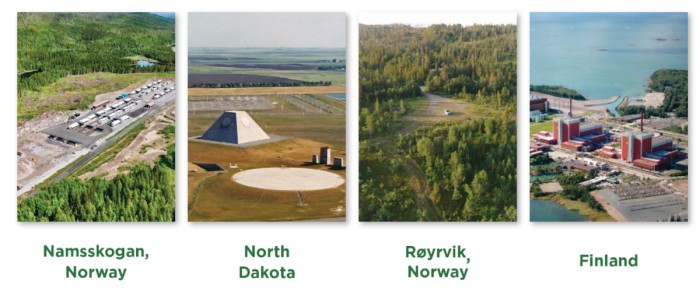
Source: Bitzero Holdings Inc.
According to CEO Mohammed Bakhashwain, each million dollars of capital deployed into Bitzero’s grid and mining equipment generates roughly $700,000 in annual net profit. That efficiency comes from vertical integration: the company owns its high-voltage connections and operates as a licensed grid operator at the 132 kV level, eliminating middle-layer grid fees that most competitors still pay. With expansion capacity exceeding 320 MW in Norway, a one-gigawatt campus in Finland, and up to 300 MW staged in North Dakota, Bitzero has achieved something rare in this market: true energy sovereignty.
And it’s this energy sovereignty that institutional investors value so much. We’re living in an age where new generation capacity is bottlenecked and new connections to the grid are almost impossible.
Bitzero’s energy sovereignty gives it a rare two-fold advantage in today’s compute economy: it can either lease scarce, low-cost power directly to hyperscalers and data-center operators, or deploy that same power internally to mine Bitcoin at industry-leading margins and potentially run its own GPU clusters. Bitcoin’s economics now heavily favor miners who control their energy destiny—at current hash difficulty, every fraction shaved off power costs drops straight to the bottom line. Bitzero’s all-in energy cost of about 4.3 cents per kWh—less than half that of major U.S. peers like Riot Platforms and Marathon Digital—puts its cost per Bitcoin near $50,000 today and below $40,000 once new hardware is fully deployed.
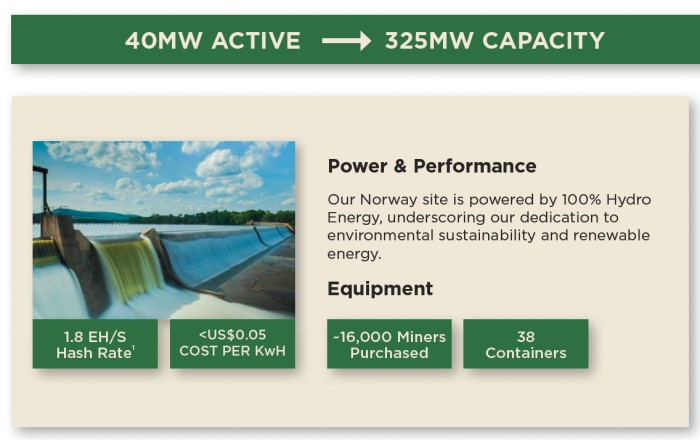
That efficiency, combined with ultra-lean operations where five staff run a 40 MW facility using fully automated monitoring and fault-response systems, creates powerful optionality. When Bitcoin economics are attractive, Bitzero mines; when hyperscalers need capacity fast, it can redirect power to AI-ready data centers. This flexibility is already visible in its purpose-built 200 MW Norwegian site on a former UN airbase, designed exclusively for AI compute and expandable to 500 MW on offshore-wind-backed grid capacity—turning energy control into a switchable revenue engine across both Bitcoin and AI.
The real inflection point for BitZero (NASDAQ: AIBZ, CSE: AIBZ-U) in 2026 may now be its newly announced 110 MW Norway project, which has the potential to transform the company from a profitable Bitcoin miner into a major AI infrastructure and hyperscaler landlord almost overnight.
Under the binding letter of interest, the site would generate roughly $176 million in annual recurring revenue through long-term contracted compute capacity, with the customer covering energy costs separately and pricing escalating by 3% annually. That structure dramatically improves margin visibility and reduces exposure to power-price volatility, potentially allowing the project to generate well over $135 million in annual net income once operational. Just as importantly, the project highlights why BitZero’s Norwegian assets are so strategically valuable in today’s market: while many competing AI data-center developments face 3–5 year build timelines due to grid bottlenecks and permitting delays, BitZero believes this facility could be delivered as early as Q3 next year thanks to already-secured power access, existing infrastructure, and partnerships with established EPC contractors and cooling-system providers. In a market where hyperscalers are desperately searching for immediately deployable capacity, that speed-to-market advantage could prove enormously valuable.
Skyrocketing valuations in the AI-space
The handful of technology companies that have successfully built a proprietary energy moat similar to BitZero’s now command multi-billion-dollar valuations. Yet despite rising institutional interest in BitZero’s power-first model and asset base, the company remains meaningfully undervalued relative to peers.
Investors in names like TeraWulf (WULF) and BitMine Immersion (BMNR) have seen one-year gains of more than +554% and +269%, respectively.
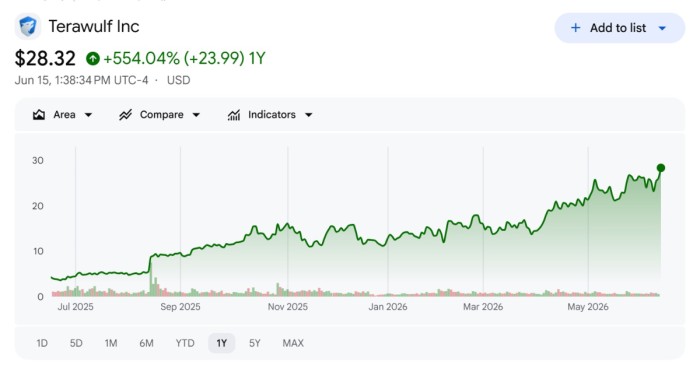
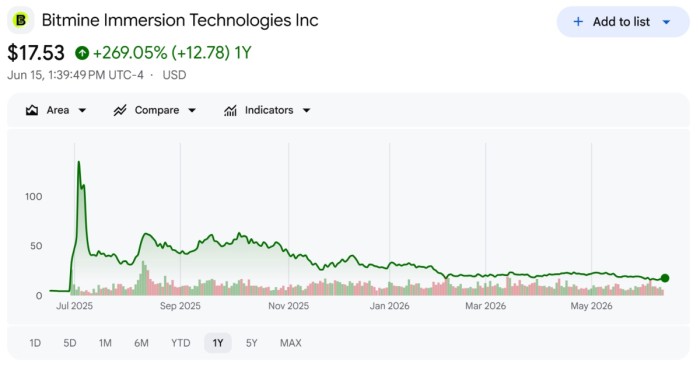
Smart money has learnt that the real advantage in compute and crypto mining is cheap, scalable electricity, and this reality is repeating cycle after cycle. The dynamic in 2026 is no different.
Investors seeking exposure to the power side of the AI boom are increasingly looking beyond traditional technology names and toward companies positioned to benefit from surging electricity demand. Vistra Corp. (NYSE: VST) has emerged as one of the market’s preferred power-generation plays, with a large fleet of natural gas, nuclear, and renewable assets that could benefit from the rapid expansion of data centers. Eaton Corporation (NYSE: ETN) sits further down the value chain, supplying the electrical equipment, power management systems, and grid infrastructure needed to connect and operate energy-intensive AI facilities. Meanwhile, GE Vernova (NYSE: GEV) has become a key beneficiary of growing investment in power generation and grid modernization, as utilities and hyperscalers race to add new capacity. Together, these companies reflect a broader shift taking place across financial markets: the AI investment story is no longer just about semiconductors and software—it is increasingly about securing the electricity and infrastructure needed to power the next generation of computing.
Summing it all up, here are 3 reasons why institutional investors are looking at steady companies like BitZero:
- The capacity to switch between Bitcoin mining and AI compute gives it exposure to two booming niches in the tech industry.
- Full control of power generation, land assets and extremely low power costs
- Prime locations for data centre developers, boasting a cold climate for cooling, hydropower and proximity to consumers.
By. Tom Kool
The AI boom is triggering an unexpected and unprecedented bull run in natural gas and power stocks. If you aren’t paying attention to the energy demands of data centers, you will miss the biggest energy story of the decade. The smart money is already quietly moving into the few companies prepared to power the trillion-dollar AI machine.
Oilprice Intelligence brings you the inside view on where the next gains will come from, breaking down the market’s biggest growth driver with analysis from veteran oilmen and experts. Click here to get this crucial intel for free
IMPORTANT NOTICE AND DISCLAIMER
Neither the author nor the publisher, Oilprice.com, was paid to publish this communication concerning Bitzero Holdings, Inc. (NASDAQ: AIBZ). The owner of Oilprice.com owns shares and/or stock options of the featured company and therefore has an incentive to see the featured company’s stock perform well. The owner of Oilprice.com may buy or sell shares of the featured company at any time including at or near the time you receive this communication. This share ownership should be viewed as a major conflict with our ability to be unbiased. This is why we stress that you conduct extensive due diligence as well as seek the advice of your financial advisor or a registered broker-dealer before investing in any securities.
This communication is not, and should not be construed to be, an offer to sell or a solicitation of an offer to buy any security. Neither this communication nor the Publisher purport to provide a complete analysis of any company or its financial position. The Publisher is not, and does not purport to be, a broker-dealer or registered investment adviser. This communication is not, and should not be construed to be, personalized investment advice directed to or appropriate for any particular investor. Any investment should be made only after consulting a professional investment advisor and only after reviewing the financial statements and other pertinent corporate information about the company. Further, readers are advised to read and carefully consider the Risk Factors identified and discussed in the advertised company’s SEC, SEDAR and/or other government filings. Investing in securities is speculative and carries a high degree of risk. Past performance does not guarantee future results. This communication is based on information generally available to the public and does not contain any material, non-public information. The information on which it is based is believed to be reliable. Nevertheless, the Publisher cannot guarantee the accuracy or completeness of the information.
INDEMNIFICATION/RELEASE OF LIABILITY. By reading this communication, you acknowledge that you have read and understand this disclaimer, and further that to the greatest extent permitted under law, you release the Publisher, its affiliates, assigns and successors from any and all liability, damages, and injury from this communication. You further warrant that you are solely responsible for any financial outcome that may come from your investment decisions.
TERMS OF USE. By reading this communication you agree that you have reviewed and fully agree to the Terms of Use found here http://oilprice.com/terms-and-conditions If you do not agree to the Terms of Use http://oilprice.com/terms-and-conditions, please contact Oilprice.com to discontinue receiving future communications.
INTELLECTUAL PROPERTY. Oilprice.com is the Publisher’s trademark. All other trademarks used in this communication are the property of their respective trademark holders. The Publisher is not affiliated, connected, or associated with, and is not sponsored, approved, or originated by, the trademark holders unless otherwise stated. No claim is made by the Publisher to any rights in any third-party trademarks.