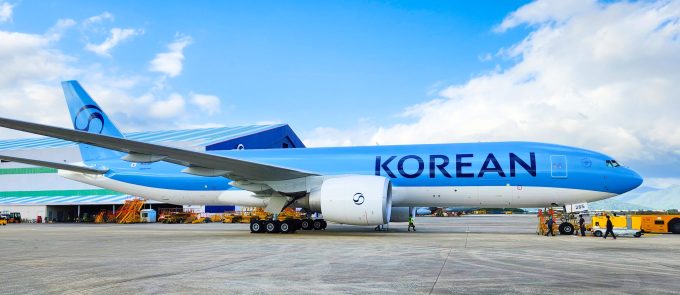

Credit: Korean Air
Korean Air expects its available belly cargo capacity to rise 20% when it integrates Asiana Airlines on 17 December, giving it more room to bring freight from across Asia into Incheon to connect with long-haul services.
The expansion comes after a third quarter in which Korean Air’s standalone cargo revenue rose 34.3% year on year, to ₩1.43tn ($1.05bn), according to its preliminary results.
Cargo traffic, measured in cargo tonne-km, increased 5.3% against a 4% increase in capacity, while yields climbed 27.5%. Compared with the second quarter, however, cargo yields fell 10.5%, while traffic rose 3.8%.
For the first nine months, cargo revenue was up 28%, to ₩4.06tn. The airline cited steady demand for AI and semiconductor shipments, alongside time-sensitive cargo ranging from solar equipment to fresh eggs.
Jaedong Eum, EVP and head of Korean Air’s cargo business division, told The Loadstar the airline would unify cargo sales, bookings, and handling worldwide on the day the combined carrier launched.
“On 17 December, all domestic and international cargo handling contracts, booking platforms, and sales systems will be completely unified,” he said. “Freight will be sold, booked, and handled entirely under the integrated Korean Air banner worldwide.”
Asiana’s short- and medium-haul Asian routes will feed Korean Air’s long-haul network through Incheon, with the combined passenger network serving more than 110 destinations. Mr Eum said transhipments from elsewhere in Asia already accounted for a “significant majority” of Korean Air’s total cargo volume, although he gave no split for AI-related shipments or a breakdown of the extra belly capacity by route.
One addition to the Asian network is Clark, in the Philippines, among 11 international routes served by Asiana alone that will move into the Korean Air network, according to ChosunBiz. It also reported that the combined carrier planned to increase Incheon-New York passenger flights from three to four a day.
Asiana’s freighter business was sold to Air Incheon, now AirZeta, in August 2025 as a condition of merger approval. Korean Air’s own fleet of 23 freighters includes 12 777Fs, seven 747-8Fs and four other 747 freighters. Mr Eum said the airline prioritised its main decks for heavy, outsized, and specialist shipments, such as AI infrastructure, and used passenger bellies for high-frequency ecommerce and express parcels.
Where the technology freight comes from
“The global expansion of data centres is serving as a primary growth engine for our cargo business,” said Mr Eum. “We are seeing sustained, high-volume demand for IT infrastructure components, particularly server racks, semiconductors, and advanced batteries.
“The supply chain is highly regionalised: we are moving server hardware originating from China and South-east Asia, semiconductor equipment and advanced batteries from Japan, and high-end semiconductor chips and power supply infrastructure originating right here in Korea.”
That traffic is concentrated on transpacific routes serving North American tech hubs. The Americas accounted for 38% of Korean Air’s Q3 cargo route revenue, up from 35% a year earlier. Mr Eum did not quantify the airline’s growth in AI-related tonnage, but pointed to IATA data showing Asia-North America cargo traffic rose 17% year on year in September, its eighth consecutive month of growth, against 7.7% globally.
“Entering the traditional November peak season, we are experiencing compounded capacity pressure on the Transpacific, driven by overlapping traditional Q4 consumer goods shipments and robust, year-round AI-related hardware demand,” he said. “Consequently, we are maximising our Asia-to-Americas capacity.”
Europe-bound space was under less pressure, as cross-border ecommerce growth moderated, he added. The airline is seeking more Europe-to-Asia freight to balance loads. On US routes, where Mr Eum described a more pronounced imbalance, Korean Air is adjusting services and focusing on yields.
Korean Air said it planned to use extra flights and charters on routes where it expected strong year-end demand. It also identified French wine and South American cherries as seasonal traffic it was targeting, alongside livestock charters and shipments for overseas factory expansions.
Pharma helps offset softer ecommerce
Changes to trade and customs rules had slowed the growth of parcels originating in China, Mr Eum said. Volumes had since stabilised as shippers adapted their customs clearance procedures.
“Any softening in general ecommerce has been comprehensively offset by our strategic pivot toward specialised cargo verticals,” he said.
“Concurrently, we are seeing strong, sustained growth in pharmaceuticals and cold-chain logistics, fuelled by global biopharma R&D and expanding domestic investments in biosimilar manufacturing facilities.” He also pointed to steady growth in exports of Korean beauty products and goods tied to Korean popular culture.
Incheon and JFK upgrades
At Incheon, Korean Air has replaced its elevating transfer vehicles, introduced automated guided vehicles, and added a second outbound bypass line. Dispatch capacity on the bypass rose from 18 to 30 unit load devices an hour, while overall terminal handling capacity increased 25%, according to Mr Eum.
He said truck bottlenecks had eased and cargo handovers were faster, although he gave no before-and-after timings.
“Post-renovation, the vast majority of our historical bottleneck issues have been resolved, with pressure now limited only to the most extreme peak acceptance windows,” he said.
Korean Air is targeting 2027 for completion of a major renovation of its JFK cargo terminal. It has also announced a daily Incheon-Newark passenger service from 22 May, using a 777-300ER.
Fifteen new freighters on order
Korean Air finalised an order including eight 777-8 freighters in September, and converted seven A350-1000 passenger aircraft orders to A350Fs last year. Mr Eum framed the investment as a way to reduce fuel burn, emissions, and operating costs.
“Our maindeck investment strategy is fundamentally driven by fleet modernisation, unit-cost efficiency, and sustainability, rather than sheer capacity,” he explained.
Korean Air’s standalone fuel bill rose 67% year on year in Q3. Mr Eum identified persistently high fuel prices and geopolitical volatility as the biggest risks for 2027, saying the airline was optimising long-haul flight paths and minimising technical stops to contain costs.
He sees high-value technology and pharma as the strongest opportunities for next year. “We do not view this as a cyclical peak,” he said of AI-related demand.
“The integration of AI chips and the subsequent build-out of global data centres represents a structural, long-term capital expenditure cycle by big tech firms, ensuring sustainable freight demand.”