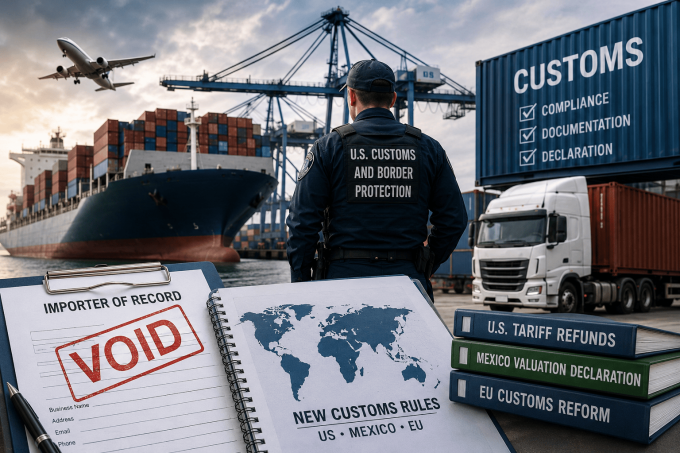

Shippers are facing a growing “compliance burden”, just as ocean and air freight networks enter a potentially volatile final quarter.
New customs requirements in the US, Mexico, and Europe are coinciding with post-Golden Week adjustments and continuing disruption across parts of Asia.
In its latest market update, Maersk warns that the combination is creating a more complex operating environment for importers, and urges companies to tighten customs data and documentation while securing transport capacity earlier, to protect Q4 supply chains.
In the US, the Customs and Border Protection (CBP) agency has begun voiding importer-of-record (IOR) numbers where businesses fail to provide complete and accurate identity information.
The policy, which took effect last month, means an importer with a voided number cannot bring goods into the US. Companies are being advised to check that their Form 5106 contains current business and email addresses and telephone numbers, while also reviewing access to their Automated Commercial Environment (ACE) accounts.
The warning comes as CBP prepares the next stage of its system for refunding tariffs paid under the International Emergency Economic Powers Act (IEEPA).
The agency is now accepting refund requests covering older, finalised entries, but only from importers with pending cases before the US Court of International Trade. Refunds will not be automatic, and eligible companies must submit a request and have bank details registered with CBP, urged Maersk.
CBP is also considering broader import disclosure requirements. An advance notice last month included questions on whether importers should provide export documentation filed by overseas suppliers, potentially increasing the amount of supply chain information companies must retain, and disclose.
Mexico has, similarly, tightened its customs regime and, since 1 October, all importers have been required to file an electronic customs valuation declaration, known as the MVE.
Maersk advised: “Make sure your commercial invoices, contracts, and payment records support the value you declare, since this filing gives Mexican Customs clearer visibility into valuation.”
Meanwhile, European importers are preparing for a longer-term overhaul of customs procedures. The revisedEU Union Customs Code, published last month, will establish a new customs authority and a Customs Data Hub, alongside a more digital, risk-based system.
The reforms include ‘Trust and Check Trader’ status, under which qualifying businesses will be given greater responsibility for managing customs formalities.
For freight operators, however, the customs changes are only part of their Q4 challenge. Maersk highlighted seasonal weather disruption in Asia, which it said had continued to affect vessel schedules, port congestion, and capacity into Europe – although it added that conditions were gradually improving.
Meanwhile, the carrier has announced that four more of its Asia-Europe services will move to Suez Canal routings from sailing around the Cape of Good Hope, potentially reducing transit times, but requiring shippers to reassess arrival dates.
However, China’s Golden Week holiday has added another variable: as factories return to production, export volumes are expected to build again, while reduced sailing frequencies around the holiday could leave wider gaps between departures.
While airfreight is usually a reliable last-minute back-up option for ocean shippers, Maersk underscored that air freight was also entering the final quarter with capacity under pressure on selected lanes. Demand for semiconductors, servers and data-centre equipment is supporting volumes, particularly between Asia and Europe and from North Asia to the US.
Indeed, Tomasz Jeleń, chief commercial officer at Rohlig SUUS Logistics, said: “The structure and volume of air freight have changed this year… Today the Gulf hubs are operating at practically full capacity again, but freight prices have risen, driven among other things by more expensive fuel and airline surcharges, and the situation in the region remains unstable.
“As a result, companies are moving part of their shipments to air freight earlier, which may make this year’s peak flatter here as well,” he warned. “This matters, because air freight is often used at the last minute, precisely for its short transit time.
“At the same time, a new and fast-growing source of demand is emerging: infrastructure for artificial intelligence and data centres.
“Servers, graphics processors, network components, and cooling systems are high in value and closely tied to schedules for bringing new computing capacity online.
“Technology customers therefore opt for air freight more often, even at higher rates. This demand partly replaces weaker ecommerce volumes and adds to the competition for cargo space during peak periods,” Mr Jeleń explained.