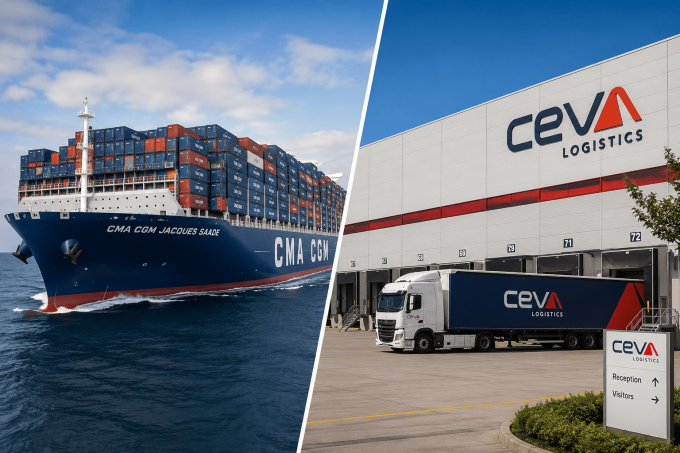

It may not have appeared at the top of CMA CGM’s Q2 release, but beneath a set of “strong” group results, Ceva Logistics’ profitability remains one of the conglomerate’s biggest challenges.
The logistics arm did improve on a difficult first quarter, EBITDA rising to $388m from $330m, and margins edging up to 7.8%. But despite revenue increasing 8.5% to $5.01bn, year on year, profitability deteriorated sharply.
The figures suggest that, after years of acquisitions, the next phase for CMA CGM’s logistics strategy will be to extract stronger returns from it.
The group continued to invest heavily in its logistics network during the quarter, underlining CEO Rodolphe Saadé’s ambition to reduce dependence on the highly cyclical container shipping market.
While Ceva Logistics increased its revenue year on year by nearly $400m, EBITDA fell 15.4%. CMA said the results reflected “pressure on freight forwarding and continued weakness in the automotive sector”.
While logistics now generates about one-third of group revenue, it is far less profitable than shipping, and the logistics division’s EBITDA margin of 7.8% fares badly in comparison with the 22.7% for container shipping.
The results reveal the task facing the forwarder after years of rapid expansion through acquisitions. CMA CGM has built a broad logistics portfolio through deals including Ceva Logistics itself, Bolloré Logistics and, most recently, its proposed acquisition of FedEx Supply Chain. Converting scale into stronger earnings is likely to be the next phase of the group’s strategy.
Happily, CMA CGM’s shipping business continued to generate exceptional returns. Second-quarter revenue rose 22%, to $9.96bn, as transported volumes increased 6%, to 6.3m teu, year on year, and average revenue per teu climbed 15.1%, to $1,575.
Shipping EBITDA jumped to $2.26bn from $1.59bn a year earlier, lifting the margin, as high freight rates more than offset the exxtra costs of geopolitical disruption in the Middle East, including higher insurance premiums, vessel immobilisation, and weaker volumes on Gulf services, said the group.
Overall revenue increased 19.2%, to $15.69bn, while EBITDA rose 31%, to $2.99bn.
The results come as Ceva undergoes a change in leadership. As previously reported by The Loadstar, FedEx’s Patrick Moebel has succeeded Mathieu Friedberg as chief executive, after he moved into a transformation role at the group.
Mr Moebel will have a lot to do. Following years of expansion and (bumpy) integration, there is more to come. The FedEx deal will triple the size of Ceva’s contract logistics footprint in North America, and add nearly 10,000 staff, giving mid-tier Ceva global scale with a broad portfolio.
The question is whether Ceva can harness that and turn growing revenue into increasing profitability.
Ceva had a busy quarter: it expanded automotive partnerships with Chinese manufacturers BYD and Chery Auto; opened an automated distribution centre in Alashankou, China; launched additional Asia-US air freight charter operations; and announced plans for last-mile subsidiary Colis Privé to acquire Paack, strengthening its ecommerce delivery network in southern Europe.
Elsewhere, CMA CGM Air Cargo acquired aircraft maintenance specialist Crystal Aero Solutions, while the group continued investing in its global terminals portfolio.
Although the proposed acquisition of FedEx Supply Chain was not referenced in the quarterly results – and has yet to complete – the deal is central to Mr Saadé’s strategy of expanding CMA CGM’s less-cyclical logistics activities. Earlier this month, he said the group would continue to grow organically in container shipping, while focusing acquisitions on logistics.
Separately, CMA CGM and infrastructure investor Stonepeak confirmed the completion of United Ports, a joint-venture holding nine CMA CGM-operated terminals across five countries. Stonepeak has acquired a 25% stake in the business through a $2.4bn investment, with the partners planning further spending on terminal expansion, cargo-handling equipment, and port decarbonisation.
“Against a backdrop of continued geopolitical instability, the group delivered solid results in the second quarter of 2026, driven by the performance of our shipping activities, the growth of our terminals and air cargo businesses, and the complementary strengths of our logistics operations,” said Mr Saadé.
Continuing tensions in the Middle East and evolving global trade policies would keep pressure on supply chains and operating costs, said the group. However, it argued that its integrated presence across shipping, logistics, terminals, and air cargo left it well positioned to adapt to changing market conditions.
For more on what the CMA CGM/FedEx deal could mean for its air cargo arm, read here.