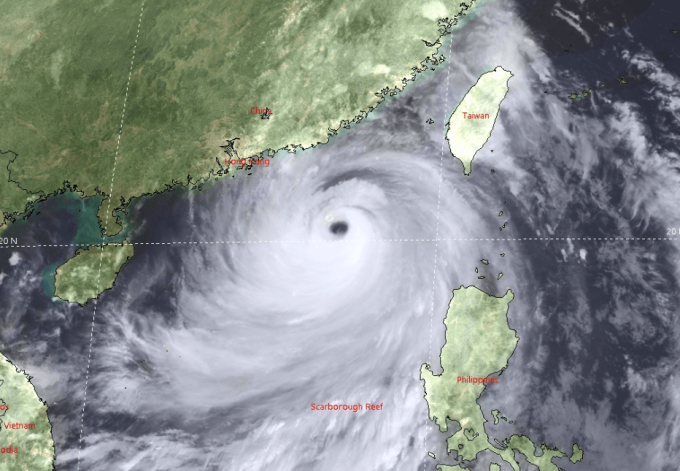

Joint Typhoon Warning Center
Typhoon Champi and persistent congestion at major Southeast Asian and South Asian ports are providing temporary support to container freight rates, disrupting vessel schedules and delaying some ships by up to three days.
However, the reprieve is unlikely to reverse the market’s downward trajectory as excess capacity, aggressive price competition and the onset of the winter slack season continue to weigh on rates.
Linerlytica’s report today stated that Champi, declared the strongest storm of 2026 after making landfall in Taiwan on Saturday, has added to congestion in North Asia, which accounts for 35% of global port logjams.
Ahead of Champi’s arrival, Taiwan’s key ports Kaohsiung, Taipei and Keelung closed last Friday and resumed operations over the weekend.
The consultancy said: “Ports across Southeast and South Asia remain under pressure from vessel bunching. The situation is compounded by the return of some services through the Suez Canal, as ships resuming the shorter route converge with vessels still sailing around the Cape of Good Hope. These disruptions are temporarily absorbing effective capacity and offering some support to spot rates.”
Nevertheless, the underlying supply-demand imbalance remains unresolved, leaving carriers struggling to sustain pricing ahead of their planned 1 November GRI.
Linerlytica said: “Carriers’ plans for a GRI on 1 November are effectively doomed as the winter slack season kicks in, with the largest shipping lines undercutting each other.”
Last Friday, the Shanghai Containerised Freight Index showed Shanghai-North Europe rates were relatively unchanged from the previous week, at $3,557 per feu. Linerlytica though, noted that the reality on the ground was less rosy.
Gemini Cooperation partners Hapag-Lloyd and Maersk are offering some of the lowest spot rates for early November shipments, at $3,000–$3,200 per feu and $3,200–$3,400 per feu, respectively. MSC, Ocean Alliance and Premier Alliance carriers, have responded with offers of around $3,400–$3,500 per feu, suggesting carriers are prioritising securing cargo volumes over maintaining higher prices.
Carriers are maintaining full capacity deployments through November, with average weekly capacity from the Far East to North Europe expected to reach a record level. Capacity is also likely to remain elevated as carriers continue to resume Suez Canal transits, meaning shortened round voyages. Half of the Asia-North Europe sailings that were routed round the Cape of Good Hope in response to Houthi attacks have been returned to the Suez, with a full reversion expected in early 2027.