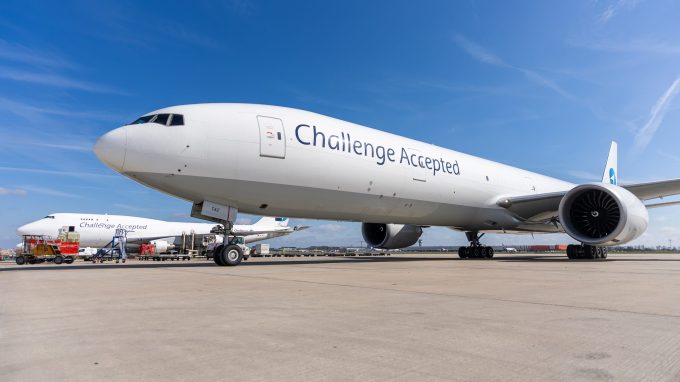
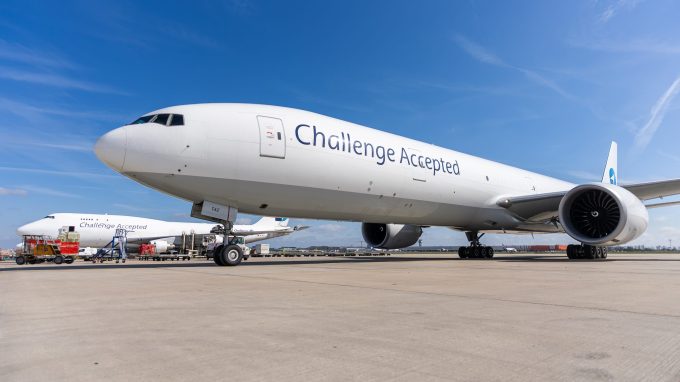
Source: Challenge Group
Challenge Group is expanding its presence in India and China with new freighter services from Liège to Mumbai and Shanghai, joining a growing list of cargo operators betting on Asia’s manufacturing and export growth.
The carrier said it would launch twice-weekly 777-300ERSF flights to Mumbai and three weekly services to Shanghai from July, strengthening links between Asia, Europe, the US and South America. The Mumbai operation replaces existing 767 services with larger aircraft, increasing available capacity into India’s commercial capital.
The move comes amid a broader rush by cargo operators into India, one of the fastest-growing airfreight markets globally.
According to Rotate data, freighter capacity between India and Europe is up 24% year on year, outpacing growth on many other major trade lanes. At the same time, Emirates SkyCargo has added dedicated freighter capacity into India, while operators including Atlas Air, FedEx and AeroLogic were set to begin services to Navi Mumbai as the city’s new airport cargo infrastructure comes online.

Source: Rotate
The capacity growth reflects rising confidence in India’s role as an alternative manufacturing base to China, as well as growing exports of pharmaceuticals, electronics and other high-value products.
Recent market data suggests demand is continuing to absorb much of the additional capacity.
WorldACD reported that chargeable weight from India to Europe increased 9% week on week in late May, helping drive a 13% increase in overall exports from the Middle East and South Asia region to Europe. By contrast, exports from the region to the US declined 4%, with Indian-origin shipments down 2%.
Despite the influx of new freighter capacity, there are few signs of oversupply. Indian forwarder LIGI Logistics this week described export capacity as “tight” across India and much of Asia, with limited spot space and extended booking lead times. The company also highlighted continuing operational constraints at Air India and ongoing congestion at Nhava Sheva port, suggesting supply chains remain under pressure.
Rates have eased from the extraordinary levels seen immediately after the outbreak of the Iran conflict, but remain relatively robust. According to TAC Index data, spot rates from India to Europe slipped from $3.93 per kg at the end of April to $3.73 per kg by 29 May, suggesting a gradual normalisation rather than a market correction.
Challenge said the new routes would support pharmaceuticals, technology shipments, industrial equipment, project cargo and other specialist freight, while strengthening the role of Liège as a gateway for global cargo flows.
Chief commercial officer Or Zak said the new services represented “another important step in the execution of our long-term growth strategy”.
“India and China continue to play an increasingly important role in global trade, and by investing in direct connectivity to both markets, we are creating new opportunities for our customers while strengthening the links between Asia, Europe, the US and South America,” he said.
However, not everyone is convinced the Indian market can absorb unlimited new capacity.
Speaking to The Loadstar last month, Cargolux chief executive Richard Forson described India as a market attracting growing interest from airlines, but warned that profitability could suffer if capacity growth outpaced demand.
“India is another country that is ramping up, albeit not as quickly as China, but they are ramping up the ability to produce and distribute,” he said.
He added: “The careful thing for India is if you keep the market in equilibrium, everybody will make a living. But if it goes out of equilibrium, where there’s too much capacity, then players will suffer.”
For now, though, the market appears to be holding up. Tight capacity, growing Europe-bound demand and continued investment by airlines suggest India remains one of the most attractive growth opportunities in global air cargo, even as carriers risk crowding into the market. Even airlines without direct India expansion plans are positioning for future growth. Japan Airlines recently strengthened its cargo offering through its partnership with Kalitta Air, highlighting the industry’s continuing focus on Asia’s manufacturing, technology and ecommerce supply chains.
Check out this week’s News in Brief podcast, featuring James Hookham, director of the Global Shippers’ Forum.