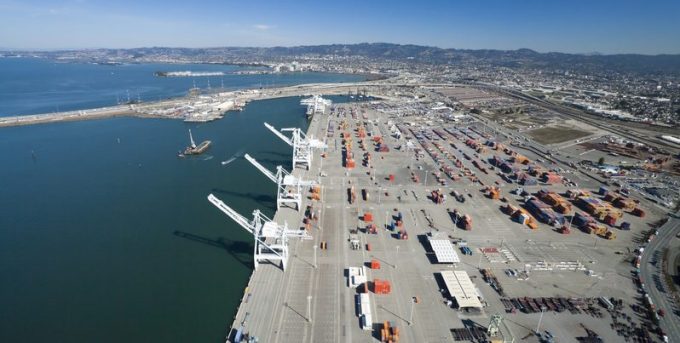

Port of Oakland
While the port complex of Los Angeles and Long Beach has been processing record volumes through the summer, tonnages have slumped at the port of Oakland and the Northwest Seaport Alliance (NWSA) ports of Seattle and Tacoma.
And for cargo owners, this means fewer options to navigate bottlenecks and disruption.
The port of Long Beach clocked up a new record for August throughput, with a 2% year-on-year gain in its teu count, which put its tally for the first eight months to 6,687,078 teu, up 1.3% on the same period last year.
And at 956,000 teu, August throughput at Los Angeles was level with its tally in 2025, which had been a record-setting year.
The twin-port complex in southern California benefited from an extended peak season, and front-loading by companies trying to beat looming higher costs. Additional impetus came from the situation at the Panama Canal’s transit restrictions, owing to low water levels that caused some diversions of cargo flows.
According to Gene Seroka, executive director of the port of Los Angeles, more than 5% of cargo shifted from US south and east coast ports in response to the canal restrictions and the problems in the Middle East.
Apparently the LA-LB San Pedro Bay complex also drew in some traffic from other US Pacific coast ports.
Container volume at Oakland dropped 9.6% year on year in August, with imports down 15% and exports 1.2% lower than a year earlier. At the NWSA container throughput was down 8.2% year on year, as imports fell 10.3% and exports sank 2.1%.
These declines are no isolated slips. In July Oakland suffered an 11.4% drop in volume from July 2025, as imports slumped 14%. June saw a 12.8% year-on-year fall in container volumes and a 16.3% drop in containerized imports.
The NWSA ports suffered a slump of nearly 15% in container volume in June, as imports contracted 27%. It fared better in July, as container volume shrank 4.2% from a year earlier.
Oakland’s outgoing port maritime director Brian Brandes (who joined the port of Long Beach in August) called the dynamic “not a seasonal dip, but a market recalibration”, adding: “Importers and exporters are adjusting their supply chain timing and routing decisions in response to evolving conditions.”
Ocean carriers have also changed their tune, consolidating traffic across fewer sailings and port calls. Vessel calls at Oakland were down 9% year on year in August.
These developments run counter to cargo owners’ efforts to reduce supply chain risk by diversifying carrier and routing options.
Recent reports from the LA-LB complex indicate that flows to the interior have been running without problems, but port executives have warned that drayage capacity was strained.
By late August, container dwell times at marine terminals had reached their highest level in more than 15 months. This set off alarm bells, as the US rail system has been dealing with elevated volumes caused by domestic traffic shifting to rail in response to tight truck capacity and elevated pricing.
Concerns about capacity bottlenecks in trucking and rail have fired shipper conversations about the need to use multiple carriers to minimise risk – although this weakens the bargaining leverage associated with consolidated traffic.
These discussions fit into a larger trend of supply chain diversification, which manifested itself most prominently in the accelerated adoption of the ‘China-plus-one’ sourcing strategy; but it also has ramifications for supply chain configuration.
In its Q1 26 Retail Sourcing Report, supply chain platform provider TradeBeyond said retailers were moving from “traditional, linear supply chains” and embracing regionalised, multi-hub strategies. It cited protectionist trade policies as a major driver, and stressed the need to be able to react to abrupt changes in tariffs and other measures.
“Key strategies include building supply networks that can pivot quickly, onboarding new suppliers efficiently, and maintaining visibility across the entire product lifecycle,” the authors wrote. There can be little doubt that the same stance applies to BCOs’ dealings with logistics providers and routings.
Funnelling more imports through southern California while services through alternative gateways on the US west coast are on the wane, and the associated increase in risk of congestion, is not in line with these shippers’ priorities.