Criminals posing as truck drivers and dispatchers are infiltrating US haulage firms to steal shipments, with data centre hardware and metals among the most sought-after commodities this year.
In its Thanksgiving cargo theft warning, Verisk CargoNet said criminals were exploiting staff shortages and holiday absences to gain access to carriers’ internal systems.
The intelligence company said the fraudsters were responding to job ads posted by trucking companies and, once hired, gained access to corporate email and telephone systems, allowing them to bid for shipments in the carrier’s name and then steal the freight.
In most cases investigated by Verisk CargoNet, carriers had recruited drivers or dispatchers online without ever meeting them.
The average documented value of stolen shipments in the nine months to September reached $448,456, up 72% year on year.
Truckloads of metals and enterprise computing hardware used in data centres remain attractive to criminals, particularly fully assembled server racks, networking equipment, graphics processors, and memory chips.
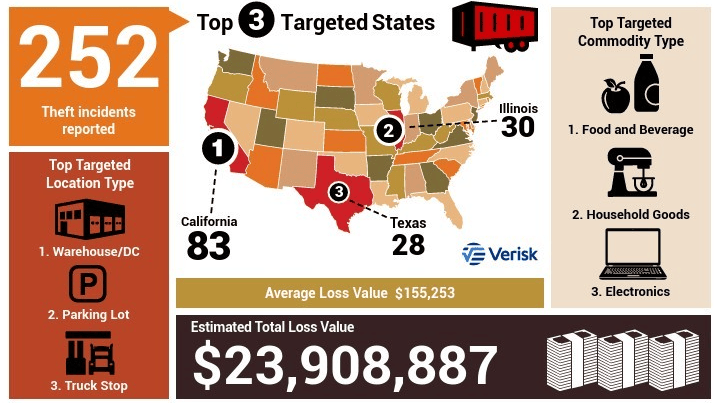
Verisk CargoNet recorded 252 cargo theft incidents across five Thanksgiving holiday periods between 2021 and 2025, an estimated $23.9m in stolen goods.
Source: Verisk
While incidents fell from a five-year peak of 79 in 2024 to 58 last year, the figure was still double that recorded in 2021. The Tuesday and Wednesday before Thanksgiving and the Monday after accounted for 62% of incidents, with California, Illinois, and Texas collectively accounting for 56% of reported thefts.
Historically, food and beverages have been the most frequently targeted commodities over the holiday, followed by household goods and electronics.
However, increasingly sophisticated identity fraud is adding to the risks posed by more traditional thefts from unattended trucks and trailers. Criminals are compromising carriers’ email accounts, purchasing carrier credentials, and deceiving hauliers into diverting shipments to alternative delivery locations.
Keith Lewis, VP of operations at Verisk CargoNet, said: “The groups behind these schemes are patient, and they plan around the calendar. A carrier’s email address and phone number are how brokers know who they are dealing with. Guard access to them the way you guard the keys to your trucks.”
Verisk CargoNet urged shippers, brokers, and carriers to increase security and verification measures, while recommending that employers meet prospective recruits, conduct thorough background and reference checks, and validate contact information.
Mr Lewis also called for greater collaboration, urging: “No single shipper, broker, or carrier can see the whole picture, and the criminals count on that.
“When one company spots a suspicious load, a fake dispatcher, or a cloned carrier and reports it quickly, everyone can benefit.”