
Feeder ships continue to dominate the boxship construction scene, including Chinese owners choosing to convert bulk carriers to container ships to beat the long wait for newbuildings, in order to capitalise on the red-hot charter market.
The Cosco group is converting a pair of Diamond 53-type open-hatch Supramax bulk carriers into 2,500 teu container vessels. The work is expected to be completed between Q3 and Q4 this year. X-Press Feeders will charter the vessels for 18 to 24 months for $27,000 per day.
The conversion includes removing onboard cranes and elevating the wheelhouse by two decks, enabling up to seven rows of containers to be stacked.
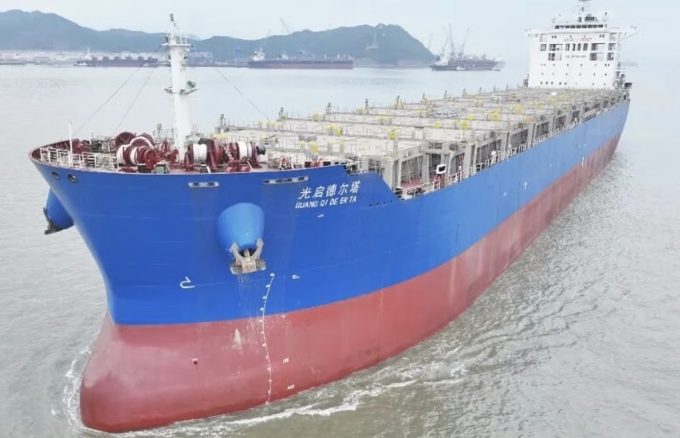
On Tuesday, China Classification Society (CCS) announced that Chan Xin 66, a 2012-built 80,000 dwt Kamsarmax bulk carrier, had been converted into a 3,600 teu container ship, claiming it is the largest project of its kind.
The vessel owner, Shenzhen Qianhai Radiant Shipping, acquired Chan Xin 66 last November and converted the ship at Zhoushan Xinya Shipbuilding. Renamed Guang Qi De Er Ta, the transformed container ship entered service on 10 June.
CCS, which supervised the five-month long project, described the conversion as challenging, involving large-scale hull structural modification, reconstructing the cargo hold, and installing a brand-new container securing system.
Major shipbuilders are busy with orders until 2029, meaning the wait for a newbuilding could be three to four years. Greenfield shipyards are getting in on the boom, but it would also take them around two years to complete a vessel.
Other than that, feeder vessels dominated the newbuilding scene this week:
Dubai-based Emarat Maritime, an owner and operator of tankers and bulk carriers, has diversified into the container sector, ordering three 930 teu ships from Hubei Guangji Shipbuilding Heavy Industry Group, with delivery expected in 2028. Emerat, owned by the Sharaf family, has options for three more ships.
Norway-based Eitzen group has ordered a pair of 900 teu electric vessels from Zhejiang Dongpeng Shipbuilding & Repairing, after winning a grant from the Norwegian government to design the ships build the needed electrification infrastructure.
Eitzen subsidiary Zen, which focuses on the group’s electrification activities, will own the vessels. The ships, to be delivered in 2028, will be deployed to intra-Europe routes to form the basis of new electric freight corridors.
Shandong Port Group’s feeder operating arm Shandong Marine Corporation has added to its orderbook, commissioning a pair of 1,100 teu ships from Shandong Marine Equipment. Costing $23.8m each, the vessels will be delivered in 2028.
On the car carrier front, Sallaum Lines booked a pair of 8,600 ceu ships from Xiamen Shipbuilding Industry. The Cypriot ship owner said it would build more car carriers as it expects more demand amid rising exports of Chinese electric vehicles.
Sallaum director Hasan Sallaum said: “With larger capacity, dual-fuel capability and an ammonia-ready design, these ships give us the flexibility to serve growing market demand while continuing to invest in lower-emission transportation.”