Algeria’s 2026 hydrocarbon bidding round is arriving at a moment when timing may matter as much as geology. Oil and gas prices have been lifted by the prolonged Middle Eastern crisis, Europe is still trying to hardwire non-Russian gas into its supply system, and former Middle Eastern investors are reassessing where long-cycle upstream capital can be redirected without excessive security risk. For Algiers, this creates a sudden opening to cement its position as Europe’s second-largest natural gas supplier but also exposes the scale of the challenges it must overcome.
In early June, the Algerian National Agency for the Valorisation of Hydrocarbon Resources (ALNAFT) has launched seven onshore conventional oil and gas blocks, with bids and ratification due in November. The offer is estimated to contain around 2.1 billion barrels of oil and 66.5 billion m3 of gas, spread across a mix of existing discoveries and exploration areas. Four of the seven blocks are in the Illizi-Ghadames basin near the Libyan and Tunisian borders, while the rest cover more oil-oriented potential in the Oued Mya and Sahara basins.
That geography matters. Algeria’s 2024 round (the first out of 5 planned) was more weighted toward gas-prone south-western acreage, where resources are attractive, but infrastructure is far less developed, thus exploration and production timelines are longer. The 2026 round shifts attention to the south-east, where the Berkine and Illizi-Ghadames basins are more mature, better connected and easier to bring to market. That makes this tender more commercially relevant in a high-price environment.
The previous round was not a failure, but it was not a roaring success either. Five of six licences were awarded, yet competition was moderate, reflecting the legacy of years in which Algeria’s upstream terms struggled to attract enough foreign capital. The 2014 round had exposed that problem clearly, with investors deterred by high taxes, heavy state control and limited commercial flexibility. The 2019 hydrocarbons law was meant to repair the damage by widening contract options and removing the previous requirement for Sonatrach to hold at least 51% in upstream projects.
The 2024 awards showed that the reset had begun. QatarEnergy entered Algeria alongside TotalEnergies in the Ahara licence, with Total as operator and each company holding 24.5%. Eni and Thailand’s PTTEP took the gas-oriented Reggane 2 project. Chinese companies also deepened their position, with Sinopec taking Hassi Berkane North and pursuing gas exploration at Guern El Guessa, while the lesser known Zhongman Petroleum (China) entered the Zerafa II gas block. Since then, Eni has signed a $1.35 billion production-sharing deal in the Zemoul El Kbar perimeter, expected to produce 415 million barrels of oil equivalent including 9.3 billion m3 of gas, while Saudi Arabia’s Midad Energy signed a $5.4 billion contract for Illizi South near the Libyan border.
This investor mix is important. Eni has been present in Algeria since 1981 and has been producing around 140,000 boe/day, making the country a core part of its portfolio. TotalEnergies is both an upstream investor and a major offtaker of Algerian LNG. QatarEnergy brings LNG expertise and strong financial backing. PTTEP, Sinopec and the Saudi entry shows that Algeria’s upstream opening is no longer just a European story. Talks with Chevron and ExxonMobil, focused largely on shale and unconventional gas potential, are still ongoing, but they point to another possible layer of interest if the commercial terms remain attractive.
The reason this matters is simple: Algeria’s export position is strong, but its production base is not. The country is Africa’s largest gas producer and natural gas accounts for roughly 49% of its hydrocarbon output. Total recoverable resources are estimated at 2.5 – 3.4 trillion m3 of gas and around 10.5 billion barrels of oil. But currently developed fields are mature, domestic demand is rising, and the export surplus is being squeezed. Production increased from around 278 million m3/day in 2021 to 287 million m3/day in 2023, but that 2023 number appear to have marked a peak rather than the start of a sustained growth cycle.
Algeria’s upstream backbone is Hassi R’Mel, the country’s largest gas field and still the main pillar of its production base after 65 years in operation. Having peaked in the mid-1990s, the field is now deeply mature, with its initial 3 trillion m3 resource base depleted to roughly 20% of its former volume (a trend mirrored by Algeria’s giant oil field Hassi Messaoud). Satellite fields and nearby tie-ins have helped slow down the decline, but Sonatrach’s room for manoeuvre is narrowing as the pool of readily available discoveries becomes narrower. Much of today’s pressure is the delayed consequence of Algeria’s 14-year ban on production-sharing and service contracts for natural gas fields between 2005 and 2019, which held back upstream momentum just as incremental supply from the discoveries of the 1980s and 1990s was beginning to fade.
Pipeline gas is still the backbone of Algeria’s export system. Around two-thirds of exports move by pipelines, mainly through the TransMed route via Tunisia and Sicily into Italy, and the Medgaz subsea link directly to Almeria in Spain. TransMed has capacity of about 32–35 billion m3/year and carried roughly 21 billion m3 in recent years. Medgaz can move around 10–10.5 billion m3/year. The third older Morocco-Spain route has been shut since 2021 after Algiers declined to renew the transit agreement amid political tensions with Rabat.
Italy is now Algeria’s central gas customer, taking roughly 20–23 billion m3/year and relying on Algerian supply for about 30% of its gas needs. Spain is more complicated politically but remains structurally important, with Algeria covering roughly 25% of its gas imports. Talks that began in March 2026 to expand Medgaz by up to 1 billion m3/year show that the appetite for Algerian pipeline gas is still there. The constraint is not demand, but deliverability.
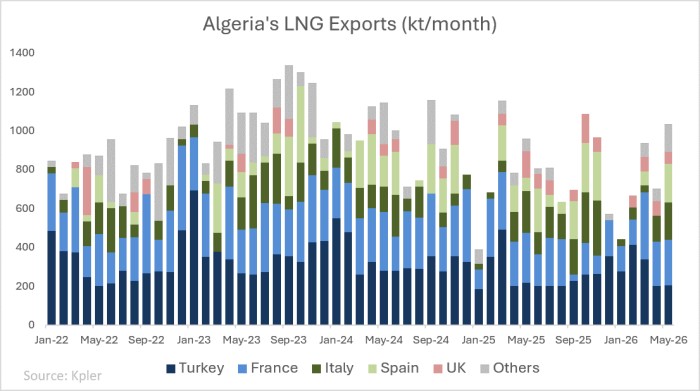
LNG tells the same story with more volatility. Algeria has two LNG export hubs: Arzew/Bethioua in the west, with about 20.8 million t/year of liquefaction capacity, and Skikda in the east, operating at around 4.5 million t/year. LNG exports surged after Europe’s break with Russian gas, rising from an average of around 900 kt/month of liquefied gas to a record 1.3 million kt in September 2023, a 60% year on year jump. France, Italy and Spain were the main European buyers, while Turkey took almost a quarter of shipments. By 2025, however, Algerian exports to Europe had slipped to around 9.5 million tonnes of LNG a year, or about 6% of the continent’s LNG imports, down roughly 2 million tonnes year-on-year. Adding the pipeline exports, by 2025 Algeria accounted for around 18% of EU natural gas imports, second only to Norway and ahead of Russia. That gives Algiers strategic leverage, especially with Italy and Spain. But it also raises the stakes: Europe needs Algeria to remain reliable, while Algeria needs new upstream investment to keep up the production.
However, the recent issue has become Algeria’s growing domestic demand. Algeria consumed around 57 billion m3/year of gas in 2025, absorbing more than half of the national output. That means every additional cubic metre must be fought over by power demand, industrial consumption, pipeline contracts and LNG cargoes. For a country where hydrocarbons account for around 10–12% of GDP and more than 90% of export revenues, the shrinking export cushion is not just an energy issue, but also a fiscal and external-balance problem.
This is why the 2026 round matters more than the acreage map suggests. Oil remains useful, but Algeria’s OPEC+ membership puts a cap on crude investment for the upcoming years. Gas is the strategic prize. It can strengthen Algeria’s role in Europe’s supply security, preserve market share in Italy and Spain, and give Sonatrach more optionality through LNG. Yet none of that is possible without new field development and infrastructure investment in underdeveloped gas provinces.
Algeria has a rare opening. Europe wants nearby gas, investors want alternatives to the Gulf’s security risk, and the country has made its upstream terms more flexible than they were a decade ago. But the window is not permanent. Mature fields, rising domestic demand and infrastructure gaps will steadily erode export capacity unless new projects move quickly. If the 2026 bidding round brings in serious capital, Algeria can turn today’s geopolitical sudden chance into a longer-term gas advantage. If it disappoints, the country risks becoming a supplier that Europe needs badly, but one with too little spare gas to fully benefit from.
By Natalia Katona for Oilprice.com
More Top Reads From Oilprice.com
- EU Says No Jet Fuel Shortage Coming Despite Middle East Supply Loss
- China Begins Tapping Oil Stockpiles as Middle East Crisis Drags On
- Kazakhstan Oil Buyers Demand More Supply as Hormuz Closure Tightens Market