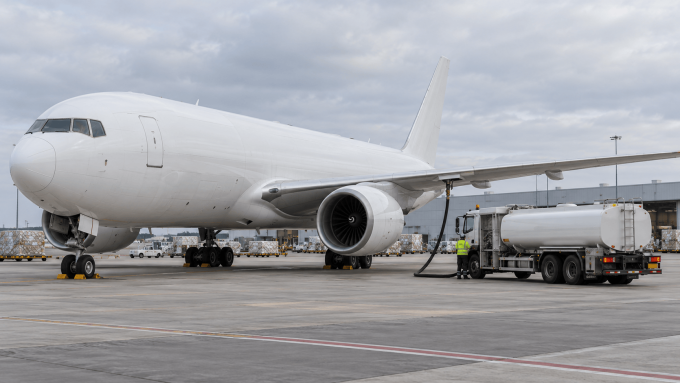

AI-generated
Rising airfreight yields have failed to keep pace with soaring fuel prices, squeezing freighter economics despite a sustained period of strong demand growth, according to Rotate.
Speaking at TIACA’s Air Cargo Forum in Miami this week, CEO Ryan Keyrouse warned that the strength of the global market concealed sharp differences in the financial performance of individual tradelanes and flight directions.
Rotate’s presentation showed fuel prices up 111% year on year in the final week of September, compared with a 26% increase in global air cargo yields, using Xeneta yield data.
Fuel prices fell during the Middle East ceasefire, before rising again, while yields had broadly stabilised.
“Airlines are feeling quite a bit of pressure when it comes to fuel prices, right now,” said Mr Keyrouse.
The pressure was particularly acute for freighter operations, he added. Rotate’s modelling of Boeing 777 freighter economics showed the gap between revenue and costs narrowing as fuel became more expensive.
“Some tradelanes are indeed quite negative at this point, with what’s happening with fuel and yields,” he said.
The company’s estimates for September illustrated the directional divide: Asia-North America 777 freighter flights generated a positive contribution of $2.55 per kg, against a negative $2.12 per kg in the reverse direction.
These are modelled flight contributions, rather than reported airline profits, but underline the importance of assessing the economics of the wider network.
“We all know that you make money coming one way, lose money going the other. That margin is tightening, so it makes network planning quite difficult these days,” said Mr Keyrouse.
Yield increases also varied considerably by market. Europe-Middle East yields were up 56% year on year in the final week of September, against +30% for Asia-North America and +24% for Asia-Middle East. Europe-North America recorded a 19% increase, while Asia–Europe yields rose 17%.
The squeeze comes despite what Mr Keyrouse described as a historically healthy period for air cargo supply and demand.
Demand growth had averaged approximately 9% over the past 36 months, against capacity growth of about 5%, he said, contrasting this with much of the period before 2020, when capacity expansion had outpaced demand.
But growth has become increasingly concentrated geographically and by commodity, creating additional challenges for carriers.
China’s share of global air cargo exports had increased from 27% to 34%, according to Mr Keyrouse, while ecommerce and AI-related cargo accounted for roughly two-thirds of demand growth over the past couple of years.
He suggested the wider contribution of AI could be greater still, given the associated movements of machinery and power generation equipment. That concentration has helped deepen the imbalance between Asian exports and return flows, leaving airlines to manage the cost of weaker backhaul sectors alongside higher fuel bills.
Rotate, nevertheless, expects global demand to continue expanding. Its forecast puts average year-on-year growth at 3.1% in the fourth quarter of 2026, followed by 5.1% in the first half of 2027.
The company identified continued growth in Chinese ecommerce exports to the US, AI-related technology exports from Taiwan and South-east Asia to the US, and increasing intra-Asia trade as key drivers.
Industry sentiment also remained relatively positive: 70% of respondents to Rotate’s sentiment index expected this year’s peak season to be at least as good as 2025’s.
Over the next 12 months, Mr Keyrouse said, Rotate expected demand growth of around 3.3%, broadly matching capacity expansion of approximately 3%. Freighter deliveries and conversions would drive much of the additional supply, with retirements also factored into its estimates.
However, a balance between global supply and demand would not mean individual markets were equally well supplied.
“Yes, next year there will be a global balance between supply and demand, but that is not at a tradelane level,” he said.
“You will see airlines and companies really fighting it out to find opportunities on those different tradelanes.”