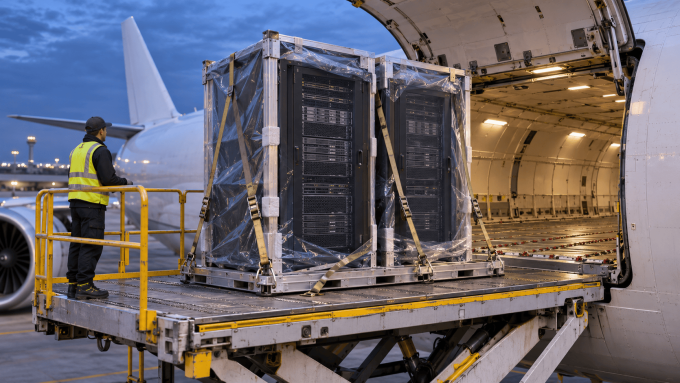

Image: AI-generated
There is no shortage of companies enjoying the AI boom – from airports to airlines and forwarders, the latest airfreight trend is filling both aircraft and coffers – but companies are now trying to find a way to prove their competitive edge in the market, whether by handling, network, or capacity.
Expeditors yesterday reported record third-quarter airfreight tonnage, up approximately 13% year on year, with hyperscaler demand a significant driver of the growth. Group revenue rose 42%, to $4.1bn, while net earnings climbed 55%, to $345m.
That demand also included shipments from Tier 1 and Tier 2 suppliers supporting AI infrastructure, the forwarder noted, extending the business beyond finished servers into the wider manufacturing supply chain.
“Air capacity remains constrained by limited fleet expansion and new aircraft delivery delays,” it said, adding that demand continued to outpace available capacity, keeping rates elevated.
However, today’s TAC Index update shows differing conditions across tradelanes.
Its global Baltic Air Freight Index slipped 1.1% in the week to 2 November, but remained 22.8% above a year earlier. China-US rates continued to rise strongly, while rates from Taiwan also increased and rates from Vietnam eased slightly.
The operational challenges behind this growth were evident in interviews at TIACA’s Air Cargo Forum in Miami last week, where Changi Airport highlighted the need to protect high-value equipment throughout its journey, including the short transfer between warehouse and aircraft.
Jaisey Yip, the airport group’s cargo business division VP, told The Loadstar that much of the airport’s cargo growth this year had come from semiconductors and AI-related infrastructure. Throughput reached approximately 1.66m tonnes in the first nine months, up 8.5% year on year.
But capturing that business required more than flight connection, she said.
“Not only are the shipments high-value, they are time-critical, and also shock- and vibration-sensitive,” she added, and production equipment could also be outsized and require main-deck freighter capacity.
To address the handling risks, Changi’s partner, SATS, had recently trialled and introduced a suspension-enabled pallet dolly, designed to reduce shock, vibration, and tilt during airside transfers.
Ms Yip said Changi was positioning itself “not only to facilitate our key exports, but also to facilitate hi-tech trades around the region to the rest of the world”.
Emirates SkyCargo is also targeting the sector, yesterday launching AI Tech, a dedicated product for server racks, semiconductors, GPUs, capital equipment, and other AI hardware.
The product combines priority loading, standardised handling procedures, and shipment monitoring through the carrier’s Dubai command centre. Expert project cargo support is available for oversized and heavy shipments, while highly specialised manufacturing equipment requires advance assessments of station capabilities.
“In July alone, we transported more than 700 tonnes of AI infrastructure across our global network, and demand has continued to grow,” said divisional SVP Badr Abbas.
Emirates said tall, dense server racks often weighed more than 3.5 tonnes, underlining the importance of main-deck capacity alongside the passenger belly network.
The demand is also generating multiple airfreight movements before equipment reaches its final installation.
Atlas Air’s Martin Drew described a two-stage supply chain, with components flown from Asian manufacturing centres to assembly locations, including Guadalajara in Mexico, before completed server racks were distributed worldwide.
“You’ve got semiconductors, chips, motherboards, and GPUs coming predominantly out of Asia into places such as Guadalajara in Mexico, where factories assemble these server racks. Then the server racks are sent all over the world,” he told The Loadstar.
The destination market extends beyond the US. Avianca Cargo CEO Diogo Elias said the airline was moving server racks from Miami into South American markets like Brazil, Uruguay, Paraguay, and Chile.
The height of the equipment – typically around 90 inches (228.6cm), he said, which made freighter main decks important for those shipments.
However, while the initial infrastructure build-out is creating substantial demand, airlines are also considering what the next phase will require.
Mr Drew said rapid technological development supported recurring replacement business.
“The technology is evolving so quickly. We hear anything from 18 months to three years, when that server rack becomes effectively obsolete and needs to be replaced.”
LATAM Cargo group CEO Andrés Bianchi, whose airline also carries AI-related cargo, raised a question about the physical form those replacement shipments would take. He wondered: “What happens when the data centre is built, and what you’re going to replace is not the rack itself, but the processor?
“Are you going to send racks again?”
For airlines planning capacity around today’s demand, continued spending on AI would not necessarily produce the same mix of bulky racks, components, and manufacturing equipment.
“This is a big opportunity today,” said Mr Bianchi. “But you’ve got to think about what is the opportunity for the future, and how that can translate into other areas of the business.”