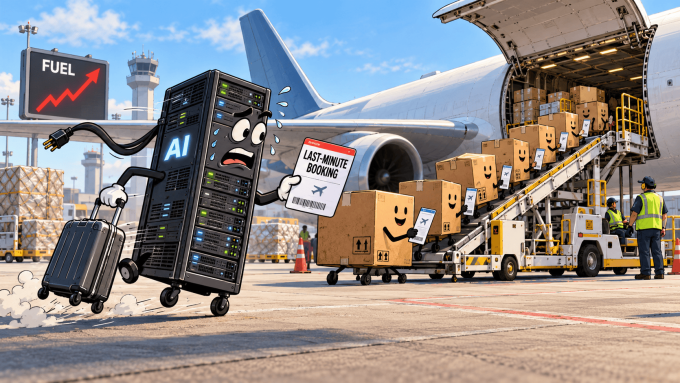

AI-generated
AI infrastructure shippers, still seeking peak-season capacity, could push air freight rates sharply higher, as demand for servers, chips, and data centre equipment adds pressure to an already firm market.
According to TAC Index, sources have reported that ecommerce customers and other major shippers with product launches had secured peak-capacity, while some AI hyperscalers had yet to book their space.
The warning comes despite a Golden Week dip in TAC’s global Baltic Air Freight Index, which fell 2.1% in the seven days to 12 October, leaving it 24.3% above a year earlier. China’s holiday ended on 7 October.
While overall rates from China to Europe and the US softened over the week, nearly all TAC’s spot rates out of Hong Kong, Shanghai, and Korea rose, with increases particularly evident in recent days.
New analysis of US imports underlines the scale of technology-related demand. Supply chain professor Jason Miller’s seasonal adjustment of Census Bureau trade data showed August air freight imports by weight reaching another record, up 20% year on year, and 42% above the 2023 average.
Computer parts, including GPUs, contributed an additional 12,932 tonnes, compared with August last year, while prepared unrecorded media, including memory, added 11,111 tonnes. Electrical power equipment and insulated wire and cables were also among the leading contributors.
Mr Miller said these categories pointed to the “disproportionate role” of investment in the physical infrastructure supporting AI computing in generating freight demand.
His findings concern US air imports, but forwarder Forto also identified a broad shift towards technology in its third-quarter market analysis.
Semiconductors, AI hardware, servers, and data centre infrastructure were the principal growth drivers, it said, while ecommerce had declined in relative importance.
And the changing demand picture is also influencing how forwarders secure capacity.
Speaking at an industry event in Liège last month, DSV’s global head of airfreight, Stefan Krikken, said forwarders needed to balance firm capacity commitments with more flexible airline bookings and their own flying programmes, taking account of hyperscaler demand and constraints at cargo gateways.
Hyperscaler demand was among the factors shaping those decisions, alongside the ability of gateways to accommodate the cargo.
Morrison Express has also identified growing hyperscaler production in South-east Asia, and exceptionally high Taiwanese volumes as factors prompting a reassessment of its gateways.
However, stronger demand and higher rates may offer carriers less financial relief than the headline figures suggest.
TAC reported that jet fuel prices rose a further 3.1% in the week to 9 October, citing IATA’s Jet Fuel Price Monitor, taking the year-on-year increase to 111.2%. And in his latest JTD Advisory briefing, founder David Kerr warned that fuel costs were rising faster than freight rates, putting pressure on operating margins.
He expects fuel surcharge resets in the second half of October, and identified four-engine freighters as the aircraft most likely to face pressure to reprice, or be parked.
Published surcharges already illustrate the pressure on shipping costs. Cathay Cargo’s Hong Kong-origin long-haul fuel surcharge rose almost 26%, from HK$11.20 to HK$14.10 (US$1.42-$1.79) per kg, for the first half of October. DHL Air UK’s equivalent charge increased 4.1% week on week, to HK$12.80 per kg for 12–18 October, although it remained below its late-September level.
Japan Airlines will raise its fuel surcharge on domestic exports bound for the Americas and Europe from ¥185 ($1.16) to ¥192 per kg on 16 October, an increase of 3.8%. Its medium-haul and short-haul Asian surcharges will rise by around 4%.
The impact on individual operators will depend on their fuel exposure and ability to recover costs, but the combination adds another pricing risk for shippers seeking remaining peak-season space.
For those AI customers still to secure capacity, the question is how much room remains, and what it will cost.